

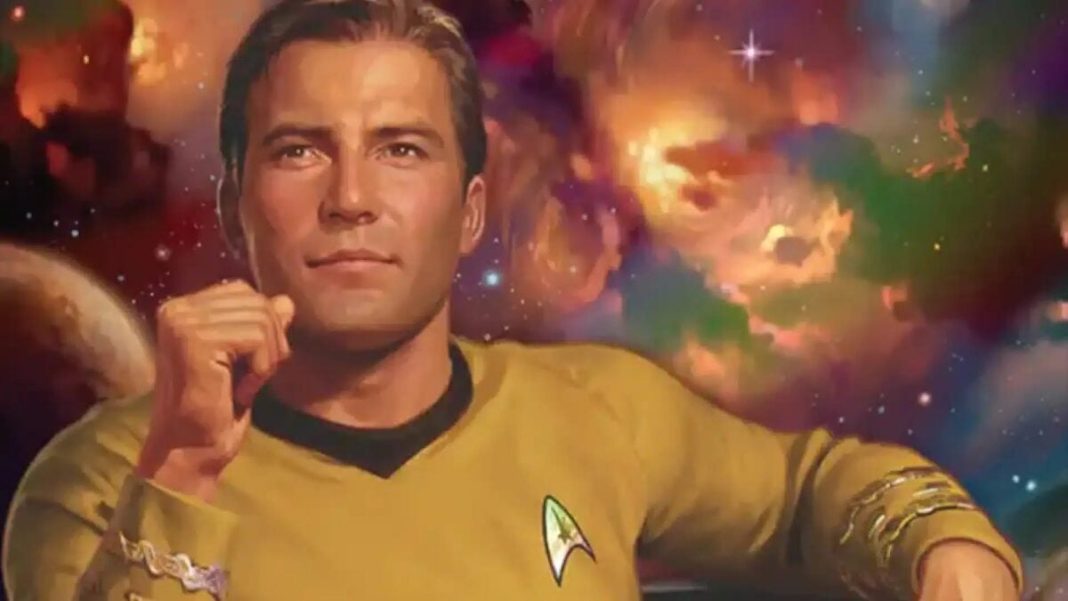
The Universes Beyond initiative in Magic: The Gathering has brought the 30-year-old card game to some interesting places. Some are steeped in the high fantasy archetype that Magic is known for, like The Lord of the Rings and Final Fantasy, while others are attempting to expand those universes beyond the norm, like the recent Marvel Super Heroes and Teenage Mutant Ninja Turtles expansions.
In November, Magic will travel to a universe set in the final frontier, in a place where no Universes Beyond set has gone before, with Star Trek. Mashing six decades’ worth of television shows, films, and more into a single card game expansion seems Herculean, but the design team says they’re more than up to the task, with the first few cards of the set being revealed on July 14.
At MagicCon: Amsterdam, I sat down with two key members of the Star Trek design team, principal game designer Gavin Verhey and senior editor Matt Tabak, to talk about bringing Star Trek‘s characters, themes, and dilemmas to the storied card game.
Fitting Star Trek into Magic
The biggest challenge from the onset was figuring out how to maximize Star Trek‘s character-focused approach to storytelling. There is action, of course, but the series has always been more about the people than the explosions.
“With Star Trek, we have a franchise that is more about talking, moral dilemmas, and character situations, rather than fighting,” Verhey said. “There is fighting, stuff blows up and spacecraft shoot lasers at each other, but it’s a lot more about the other stuff.”
Magic: The Gathering, by contrast, is a game where people, as Verhey puts it, “like attacking for two damage.” However, he believes the mechanical suite the team has built for this Star Trek set, one that focuses on engine building and “go long” strategies rather than quick wins, fits the source material.
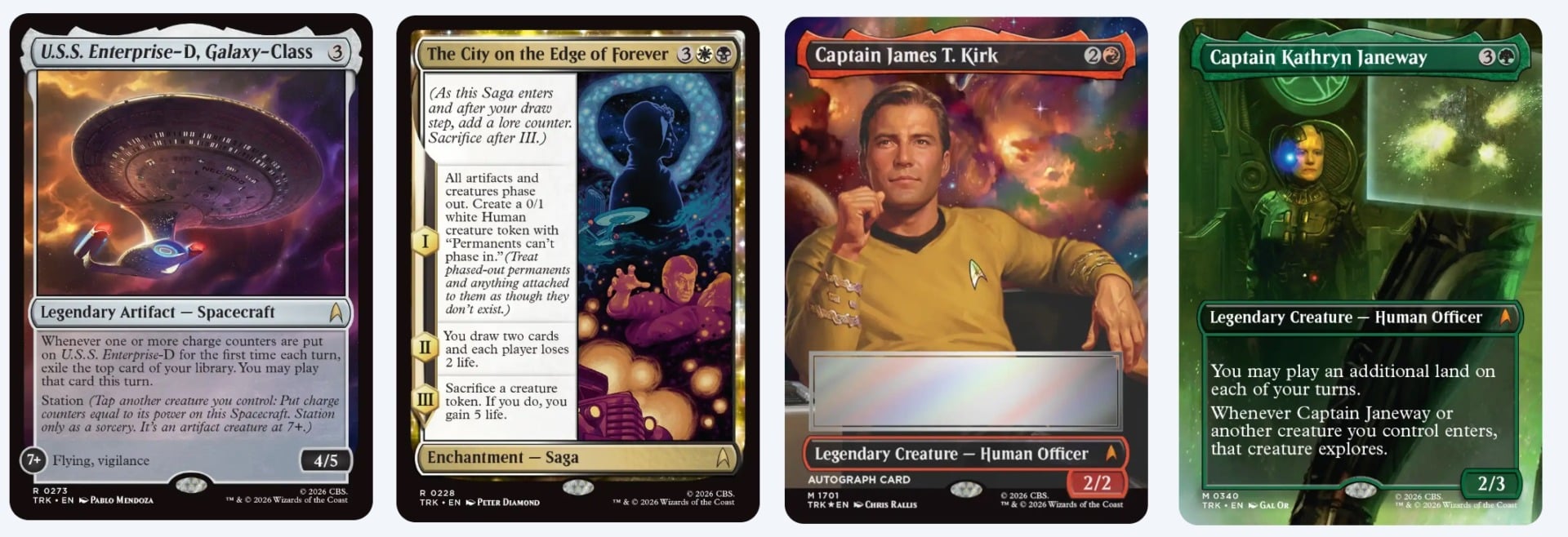
That’s not to say that speedy strategies aren’t present in the set. “The Klingons will still get into the ‘red zone’ and beat up opponents,” Verhey said, “but mechanics like Dilemma are great for focusing on the moral challenges of Star Trek, or trying to build something that isn’t just about attacking.”
One card Verhey and Tabak are particularly excited about, that we haven’t seen yet, involves the character Q. “There’s a very fun Q card, and I think he is a goofball that I’ve always enjoyed,” Verhey said. “Yeah, we spent a lot of time on Q, making sure that we captured his, you know, ‘Q-ness,’” added Tabak.
A new Dilemma
Dilemma, one of the mechanics revealed during the Star Trek first look event on July 14, gives extra benefits when players cast spells that offer different modes for resolving. The example card, Seven of Nine, lets you draw an extra card whenever you have to make a choice on a modal spell.
Modal spells have proven to be very strong in Magic‘s history, so crafting this new mechanic was done with the past in mind. “It’d be very easy to do something that’s parasitic, where it only really works with what’s happening in the set around it,” Verhey said. “I really wanted something that lets you look at all the modal cards—Vision Charm, Retreat to Coralheim, Cryptic Command—and realize that Dilemma cards work with all of these. We even made the wording [of Dilemma] such that it works with the Bloomburrow paw print cards and [Outlaws of Thunder Junction’s] Spree.”
For Verhey, crafting a mechanic that can have weight with some of the game’s older cards makes the entire experience more fun. “Magic is a game with a bunch of interlocking pieces; it’s been around for over 30 years,” Verhey said. “I’m sure people will find crazy stuff to do with Dilemmas that are easy to keep rocking over and over, and that mission, that deck-building quest is really unique and pretty cool.”
Parallels with Edge of Eternities
Thanks to some unplanned serendipity in the design stage, development of the Star Trek set ran parallel with Edge of Eternities, an in-universe Magic set that takes place in the far reaches of space. Edge released in August 2025, and it was lauded as one of the best expansions of the entire year.
Crucially, the set introduced Spacecraft into the game as a Vehicle type, and with Spacecraft came the Station mechanic—or the means of “manning” the Spacecraft in order to access stronger abilities. While Edge was already in development when design on the Star Trek set started, the two teams didn’t immediately begin merging ideas.
“With Edge, they knew they wanted some kind of big Spacecraft mechanic, it’s a key part of space, so they ran ahead and started working on it,” Verhey explains. “Some time later, Star Trek design begins, and we want to do Spacecraft, so we start running with it and make our own Spacecraft mechanic that is different from what Edge is doing.”
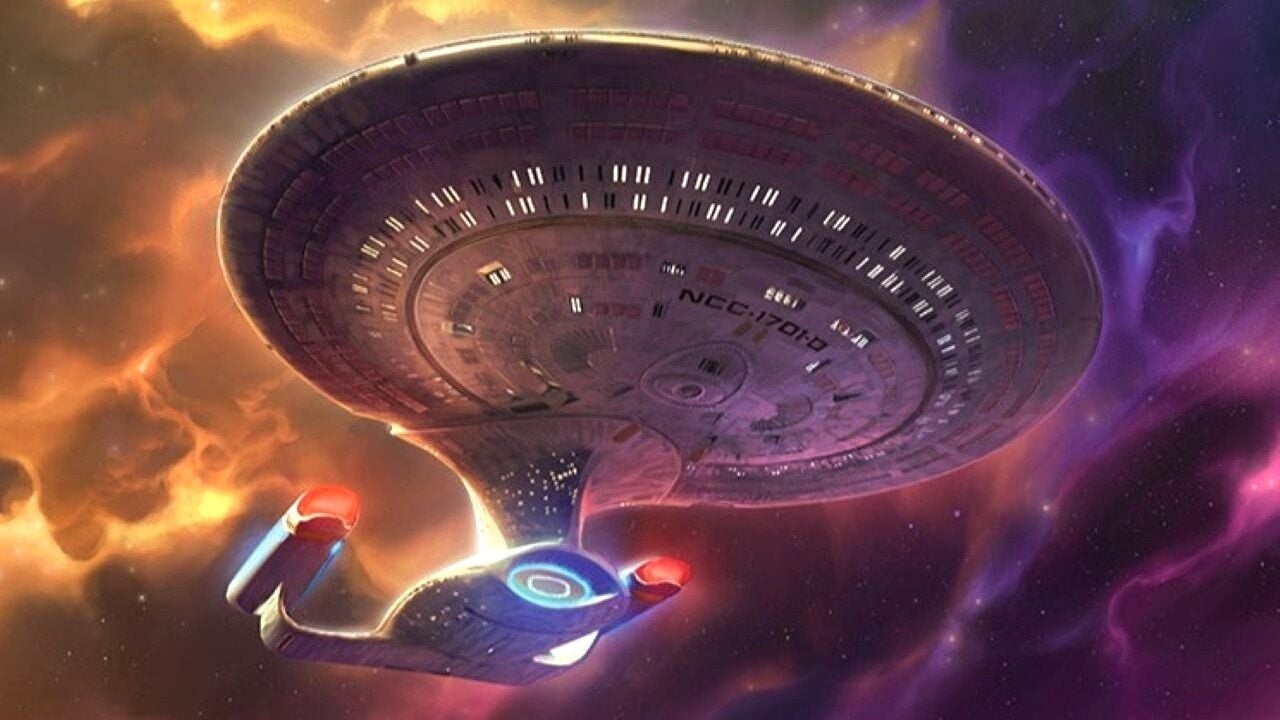
Eventually, both teams realized that having two different takes on Spacecraft wasn’t the best use of their time. “After a while, we said ‘Okay, we should not do two different Spacecraft mechanics,’” Verhey said. “These will not be the last times Magic goes to space, there’ll be something in the future where we want to do that, so let’s try and find one mechanic that is the Spacecraft mechanic for Magic. So, the Edge of Eternities team did a bunch of work, came up with their spacecraft, and we lined up to that.”
“Star cred”
With 60 years of source material to parse through, adapting Star Trek to Magic: The Gathering would require the street cred—or “star cred”—of some real Trekkies. While Verhey says he’s been watching since the original series—Deep Space Nine is his favorite, for those curious—it’s Tabak’s pedigree in the Star Trek universe that shows how deep the knowledge base of the design team runs; before working for Wizards of the Coast on Magic, Tabak worked for Paramount Parks, in a Las Vegas hotel experience called, fittingly, Star Trek: The Experience.
“It was like walking onto the Deep Space Nine promenade,” Tabak said. “It had motion simulator rides, one with the Borg and one with the Klingons. You could interact with fully costumed actors, with Klingons and Borg and Ferengi. Quark’s Bar was there. It was a fantastic experience.”
Tabak says his experience at Star Trek: The Experience helped strengthen his love for the final frontier.
“It was like being at a Star Trek convention every day at work, and I worked there from opening day, for about four or five years, before moving on to the Seattle area and getting into gaming,” Tabak said. “I have seen Star Trek fandom. I have lived in it up close and personal. Thousands of Star Trek fans from all around the world would descend upon my workplace and exist on Deep Space Nine for a couple of hours. I got to talk to people about their fandom, it helped mold my own, and it paid off when I got to marry it and my love of Magic and bring it all together.”
Deep cuts? Nein.
Because of this deep knowledge, some references were considered a bit too obscure, and were left on the cutting room floor. In one instance, a silly nod to an early ’90s VCR game was left out of the Star Trek set—”we couldn’t quite get ‘Experience Bij!’ into the set,” Verhey says—only for that reference to then appear in official Star Trek media.
“I did argue for it for a while, and this was before Lower Decks included it as a reference,” Tabak adds. “I was vindicated when the reference I wanted to put in showed up there. ‘See, I told you!’”
Ultimately, the design team thinks they’ve more than met the challenge of bringing Magic where no one has gone before. “I think we have enough street cred, and I think the set will speak for itself on this front,” Tabak said. “I think the set will be an incredible treasure trove of Easter eggs and delight both Star Trek fans and non-Star Trek fans. Really, it’s a great way to get into Magic, Star Trek, or both.”
Magic: The Gathering‘s Star Trek expansion is set to launch in local game stores and big-box retailers on November 13.